How to Calculate BMI and Why Malaysian Ranges Differ
The formula, the Asian cut-offs used in Malaysia, and when BMI misleads.

BMI is weight in kilograms divided by height in metres squared. In Malaysia the healthy range ends at 22.9 and obesity starts at 27.5.
Learning how to calculate BMI is simple enough. The harder part is knowing which ranges to read it against, because the cut-offs used in Malaysia differ from the international chart, and that difference changes the conclusion for a lot of people.
How to calculate BMI: the formula
Divide your weight in kilograms by your height in metres squared. So someone weighing 72 kg at 1.68 m gets 72 divided by 2.82, which is 25.5. On the international chart that reads as merely overweight. Against the Asian cut-offs, however, it already sits in the range that warrants attention.
Why Malaysia uses lower cut-offs
Metabolic risk in Asian populations rises at a lower BMI than in European populations, partly because fat distributes more around the internal organs. Therefore the healthy range ends at 22.9 rather than 24.9, and obesity begins at 27.5 rather than 30.
The ranges used here
- Below 18.5: underweight
- 18.5 to 22.9: healthy range
- 23.0 to 27.4: pre-obese
- 27.5 to 32.4: obese I
- 32.5 to 37.4: obese II
- 37.5 and above: obese III
What knowing how to calculate BMI does not tell you
BMI does not distinguish muscle from fat, and it does not show where fat sits. So two groups get misleading readings. First, people who train with resistance, since muscle is denser and lifts BMI although risk stays low. Second, older adults who have lost muscle, whose BMI can look fine although body fat already runs high.
Measurements that tell you more
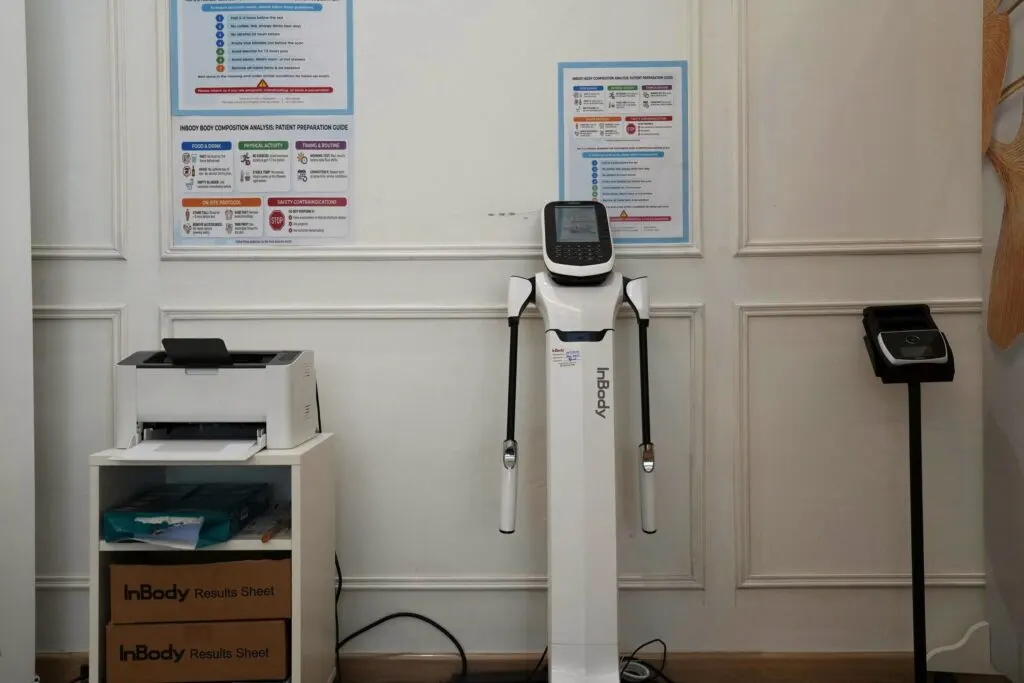
Measure your waist at the midpoint between your lowest rib and the top of your hip bone, standing, at the end of a normal breath out. Measuring at the navel instead gives a different number on the same body. Above 90 cm for men or 80 cm for women indicates visceral fat regardless of BMI. Waist to height is simpler still: your waist should measure less than half your height. For actual composition, a body composition test separates fat from muscle.
Healthy weight range at common heights
The formula is easier to use in reverse. Instead of working out your BMI, read the weight band that already sits inside the healthy range for your height. These figures use the Malaysian cut-offs, so they are lower than the bands you will see on an international chart.
| Height | Healthy range (BMI 18.5 to 22.9) | Overweight from | Obese from |
|---|---|---|---|
| 150 cm | 41.6 to 51.5 kg | 51.8 kg | 61.9 kg |
| 155 cm | 44.4 to 55.0 kg | 55.3 kg | 66.1 kg |
| 160 cm | 47.4 to 58.6 kg | 58.9 kg | 70.4 kg |
| 165 cm | 50.4 to 62.3 kg | 62.6 kg | 74.9 kg |
| 170 cm | 53.5 to 66.2 kg | 66.5 kg | 79.5 kg |
| 175 cm | 56.7 to 70.1 kg | 70.4 kg | 84.2 kg |
| 180 cm | 59.9 to 74.2 kg | 74.5 kg | 89.1 kg |
| 185 cm | 63.3 to 78.4 kg | 78.7 kg | 94.1 kg |
Read these as bands, not targets. Sitting one or two kilograms outside a band means very little on its own. Sitting ten kilograms outside it, with a waist above the threshold below, means rather more.
Three people, the same BMI, three different answers
This is the part a calculator cannot do for you, and it is the reason we read BMI alongside two other numbers rather than on its own.
| Who | BMI | What the other numbers show | What it means |
|---|---|---|---|
| Man, 34, lifts three times a week | 26.0 | Waist 84 cm, body fat 16 per cent | BMI reads overweight. The waist and body fat do not. The muscle is lifting the number, and nothing here needs treating. |
| Woman, 52, no exercise, desk job | 22.5 | Waist 86 cm, body fat 38 per cent | BMI reads healthy. The waist is over the 80 cm threshold and body fat is high. This is the pattern BMI misses most often. |
| Man, 45, weight up 8 kg in two years | 28.4 | Waist 102 cm, HbA1c at the upper end of range | All three agree. This is the case worth acting on, and the blood work matters more than the scale. |
The middle row has a name: normal weight with high body fat. It is common in Malaysia, it is invisible to BMI, and it is the single best argument for measuring your waist even when the scale looks fine.
BMI, waist and body fat side by side
| Measure | What it captures | What it misses | Threshold used here |
|---|---|---|---|
| BMI | Weight relative to height, across a whole population | Muscle against fat, and where the fat sits | Healthy to 22.9, obese from 27.5 |
| Waist circumference | Visceral fat, the kind that sits around the organs | Total body fat, and muscle mass | 90 cm men, 80 cm women |
| Waist to height | The same signal, adjusted for how tall you are | Muscle mass | Waist under half your height |
| Body fat percentage | Actual composition, fat against muscle against water | Where the fat sits | Read against age and sex |
If you only ever measure two of these, measure BMI and your waist. Between them they catch most of what the scale alone hides.
Three worked examples, step by step
The formula is simple, but the step people get wrong most often is converting centimetres to metres. The three examples below show every step.
| Detail | Example A | Example B | Example C |
|---|---|---|---|
| Weight | 58 kg | 72 kg | 95 kg |
| Height | 160 cm | 165 cm | 178 cm |
| Height in metres | 1.60 m | 1.65 m | 1.78 m |
| Height squared | 2.56 | 2.72 | 3.17 |
| BMI | 22.7 | 26.5 | 30.0 |
| Malaysian category | Healthy range | Pre-obese | Obese I |
| International chart | Healthy range | Overweight | Obese |
Look at Example B. The number is the same, but the conclusion changes depending on which chart you read it against. That is not a calculation error, it is the gap between two sets of ranges.
The four most common mistakes
- Using centimetres in the formula. Dividing 72 by 165 squared gives 0.0026. Height has to be converted to metres first.
- Forgetting to square. Dividing weight by height alone produces a number that means nothing. Height has to be multiplied by itself.
- Using an old height. Height changes after middle age, and a two centimetre difference is enough to move the category for anyone sitting on a boundary.
- Measuring height in shoes. Measure without shoes, standing straight, heels against the wall, looking level ahead.
How to work out BMI without a calculator
If you want a quick estimate with no tool, there is a shortcut. Take your height in metres, multiply it by itself, then multiply by 23. The answer is the weight at which your BMI reaches 23, which is where the pre-obese range starts in Malaysia.
For someone 1.65 m tall: 1.65 times 1.65 is 2.72, and 2.72 times 23 is 62.6 kg. So at that height, anything above 62.6 kg is already in the pre-obese range. One calculation, one threshold, easy to remember.
BMI in pounds and feet
If your numbers are in pounds and feet, convert first. Divide pounds by 2.205 for kilograms. Multiply feet by 0.3048 for metres, and each inch is 0.0254 metres.
There is also a direct imperial formula: weight in pounds times 703, divided by height in inches squared. The answer is the same. We suggest converting to metric first, because every Malaysian reference range is published in kilograms and centimetres.
The questions a doctor asks after seeing your BMI
BMI is never read on its own in a consultation. It opens the conversation, and the questions below decide whether the number means anything for you.
- Whether your weight has been stable, rising or falling over two years, and by how much
- Your waist measurement, since it can flag risk even at a normal BMI
- What kind of activity you do, and specifically whether any of it is resistance training
- Your current medication, because several categories cause weight gain
- Sleep quality, since short sleep changes hunger hormones within days
- Family history of type 2 diabetes or heart disease
- Your most recent blood results, if you have any
If the answers to all of these come back clean, a slightly raised BMI is often not a problem. If several do not, then even a normal BMI is not yet reassurance.
What to do next
Use our BMI calculator for the quick number, the ideal weight calculator for the band at your height, then waist to hip ratio to see where fat sits. If both fall outside range, or symptoms such as post-meal fatigue appear, read the weight management guide and the metabolic health pathway. Cut-offs follow the Ministry of Health Malaysia and the World Health Organization.
Every iLIV guide is written and reviewed under our editorial standards, and each one carries the name of the reviewing doctor together with their MMC registration number.
Frequently Asked
How do I calculate BMI?
Divide weight in kilograms by height in metres squared. 72 kg at 1.68 m gives 25.5.
Why are Malaysian ranges different?
Metabolic risk rises at a lower BMI in Asian populations, so the healthy range ends at 22.9.
My BMI is normal but my waist is large. Is that a problem?
Yes. A waist above 90 cm for men or 80 cm for women indicates visceral fat even at a normal BMI.
Related tests
Which tests are needed is decided at the consultation, not before.
Treatments on the same pathway
Not all of these suit everyone. The doctor assesses first.

Start with one conversation
An initial consultation to understand your situation before any testing is recommended.
Damansara Perdana · I-City, Shah Alam · +60 14-801 6493